
The moment an auditor starts asking:
- Who reviews AI-generated code?
- What process do they follow?
- How do you verify it happens?
- Where is the documentation?
- Who approved the policy?
Those five questions expose a gap that most security tools were never built to close.
Your SAST scanner catches known vulnerability patterns.
It cannot tell an auditor who reviewed the AI-generated code, what process they followed, or where the documentation lives.
That's not a scanner failure.
That's a governance gap, and it's yours to own.
Most organizations reach this moment the same way: AI-generated code ships first, governance comes later...
Usually much later...
Usually after someone asks.
When that someone is an auditor, the scramble begins.
Emails.
Engineering managers.
A process that everyone assumed existed but nobody wrote down.
That's the accountability gap.
The AI tool has no name on the org chart.
You do.
The Model Writes The Code. You Own The Consequences.
A 6-Week AI Code Governance Plan for CISOs
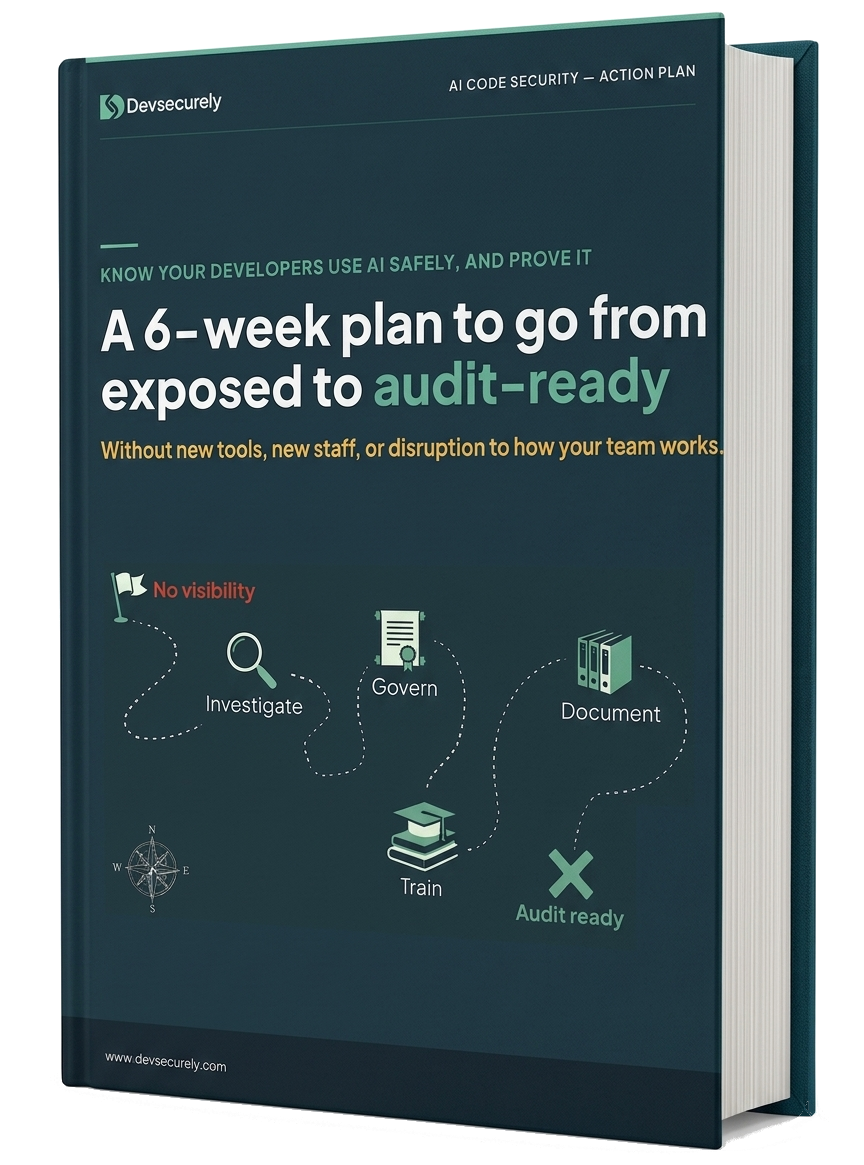
Discover Inside:
- The exact clause in your SOC 2 / ISO 27001 attestation that becomes personal liability the moment AI-generated code bypasses your SDLC
- The 5 auditor questions most CISOs can't answer yet — and the governance structure that makes each one answerable
- Why "a human approved the pull request" no longer counts as evidence, and what replaces it
- The silent reorg problem: thousands of lines of ownerless AI-generated code accumulating across your codebase — and how to map it before someone else does
- Why your SAST scanner maps the repository but doesn't secure the territory
- A practical way to classify AI code risk without buying another security platform
- The 4-step framework that gets most organizations to audit-readiness in 6 weeks
Written by an active penetration tester. Not a compliance consultant.

Imed Bounab
Professional Penetration Tester & Founder of Devsecurely
- ✓8+ Years in Penetration Testing
- ✓Advised CAC 40 Security Teams
- ✓Trained 40+ Development Teams
This guide is not built from frameworks and whitepapers.
It's built from what he finds when he gets hired to attack codebases where developers have been shipping AI-generated code for 12 months without a governance structure in place.
The accountability gap is not theoretical. He sees it on every engagement.
The 4-Step Program
- Investigate: Map exactly how AI is being used across your engineering teams. Build a risk-rated inventory before you write a single policy.
- Govern: Draft and get sign-off on an AI code governance charter. One document. Named owner. Signed by the right executive.
- Train: Run a live session where developers see AI-generated code exploited in front of them, in their own stack. They leave with a repeatable review process.
- Document: Produce the evidence set an auditor will ask for. Seven documents. Most CISOs finish in under two hours using the included templates.
Your next audit will ask the question. This gives you the answer.
15 hours.
6 weeks.
A documented governance structure you can hand to an auditor, a board, or a customer the moment they ask.